Living in a ‘developing nation’ (Cambodia) it’s easy to slag off NGOs and charity work.
I decided I’d turn this train of thought around – and try to locate some of the more inspiring players in the field. I started with Stephanie Zito – she’s located 365 gems with her ‘Give 10′ daily project! Cheers to Beth Kanter for hosting & posting my interview, more to come! http://www.bethkanter.org/give-ten/
“Generally speaking, I’ve found most Cambodians embrace the internet as a place for self-expression ‘first’, with human rights then being reflected in their opinions,” says John Weeks, an American in Cambodia who regularly consults with human rights groups on net strategy. read more…»
While most of the Internet users in Cambodia are on networking site Facebook, “Twitter is growing in leaps and bounds,” said a founder of TweetCambodia, which aggregates tweets with hashtag #cambodia.
“Cambodia has a very phone-centric culture and that’s suited well to Twitter use. We are seeing a lot more sophistication in the use of it, including the use of Khmer Unicode which is particularly interesting,” John Weeks added.
How did you find out about Twitter? A friend from the States turned me onto it and there is a guy named John Weeks who is THE guy in Cambodia about social media and he convinced me to start tweeting on a regular basis. read more…»
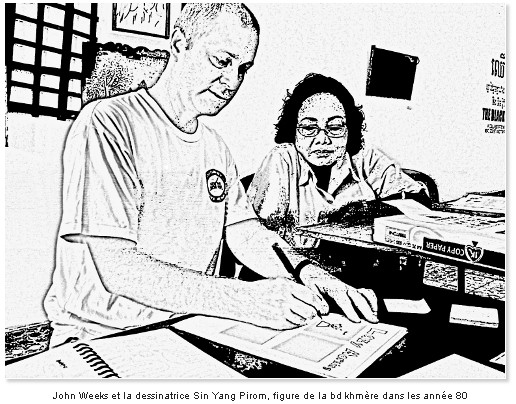
Wherever there are people and pens, comics seem to spring up. This long, comprehensive story on comics in Cambodia documents the emergence of a cartooning scene through the dust and haze of past political upheaval as a bunch of young folk try to make their dreams come true. read more…»
Something’s going on in the world of Cambodian comics. Since the first known graphic novel was published in 1964, comics artists have struggled to overcome the challenges posed by the war period, advent of television, and copyright issues. Today signs are pointing to a reinvigoration of comics, as an emerging generation of artists begins to explore new directions. Mai Lynn Miller Nguyen takes a stroll through the history of Cambodian comics and asks what the future beholds. read more…»
“One laptop per child is a great concept; one phone per person is closer to reality. Anyone with a phone in this country can already broadcast out to the internet via international SMS and Twitter. These channels will widen and get more sophisticated,” explains John Weeks, chief executive officer of House 32 web design and founder of tweetcambodia.com. read more…»
Comic art hit its peak in Cambodia in the early 1990s, but since then the local market has declined tremendously. The spread of television and a lack of training in Cambodia could partially explain this decline, organisers say. John Weeks, managing editor of Our Books, said that many Cambodian comic book artists today view themselves as illustrators rather than just cartoonists. “In the West, you have the options to slot yourself into one particular role. Here, people just have to take up what’s available,” he said. read more…»
Phnom Penh has just been wired with 3G technology, far ahead of neighbouring countries Vietnam and Thailand, giving blogs explosive potential. Yet phones still haven’t reached their peak, Weeks insists. “Users aren’t afraid of technology. But phones aren’t reaching their full potential,” he says. “If ordinary Cambodians can overcome the language barrier and literacy barriers, phones have incredible gateway potential that would dwarf the current blog boom.” read more…»
“We have a dichotomy. Cambodia has leapfrogged landlines to embrace modern, high-tech mobile phones. Users aren’t afraid of technology. But phones are not reaching their full potential,” said John Weeks, an American blogger who has lived in Phnom Penh since 2003. “If ordinary Cambodians can overcome the language barrier and literacy barriers, phones have incredible gateway potential that would dwarf the current blog boom.” read more…»
According to John Weeks, assistant managing editor of the NGO Our Books, the primary subject matter of Cambodia’s budding literary talent is that age-old favorite: “Romance, romance, romance”. The increasing interest in literature at degree level mirrors a broader trend — now “people are hungry for books and reading material in general,” Weeks says. But despite the growing demand for books in Cambodia, the infrastructure for a strong industry is still not in place. “The market is there; we just need to have more people willing to publish and distribute the work,” Weeks says. read more…»
The Khmer diaspora has had interesting effects on Khmer culture,” says John Weeks, the assistant managing editor at Our Books. Filmmakers and novelists who fled Cambodia have helped map out a record of its struggles, and émigré communities have been instrumental in keeping traditional dance and music alive after many of its best practitioners were persecuted. read more…»
Human Rights Watch continues to criticize the Cambodian government’s treatment of dissent, but bloggers are able to express at least some overt criticism. And there is no official censorship. More to the point, said John Weeks, an American who runs the House32.com Web design firm in Phnom Penh, blogs are not yet relevant to most Cambodians. “I don’t see blogs where farmers talk about rainfall, or where (motorbike-taxi drivers) complain about gas prices,” he said. (motorbike-taxi drivers) complain about gas prices,” he said. read more…»
US national John Weeks, a long-time expatriate blogger who spoke at the summit on how to ensure blog content quality, said that starting a blog involves asking yourself that very question. “It’s the search for identity played out in public,” he said, adding that the impact of blogging is understandably mitigated by its concentration among the urban middle class. read more…»
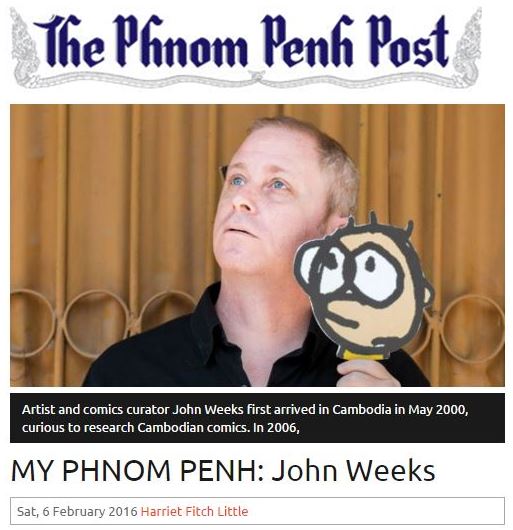
Weeks grew up in Southern California, and was an avid comic book fan and creator from early on. In college he was introduced to Cambodian culture, which led to an MA in Asian Studies in Melbourne, giving him the chance to learn the Khmer language as well as participate in Australia’s thriving DIY comics scene. He eventually moved to Cambodia for a position at an academic research center in Siem Reap, the town nearest to Angkor Wat, Cambodia’s spectacular Hindu/Buddhist ruins and largest tourist attraction. Then, in 2003, he relocated to Phnom Penh to delve into the publishing world. read more…»
It’s samizdat all right,” agrees John Weeks, who is researching Khmer literature. “But it’s battling against indifference much more than censorship. At our Indonesia exchange, a comic artist tried to talk about the idea of a cultural movement and he just got blank looks. Movement equals politics and here people after many years are quite cautious. read more…»

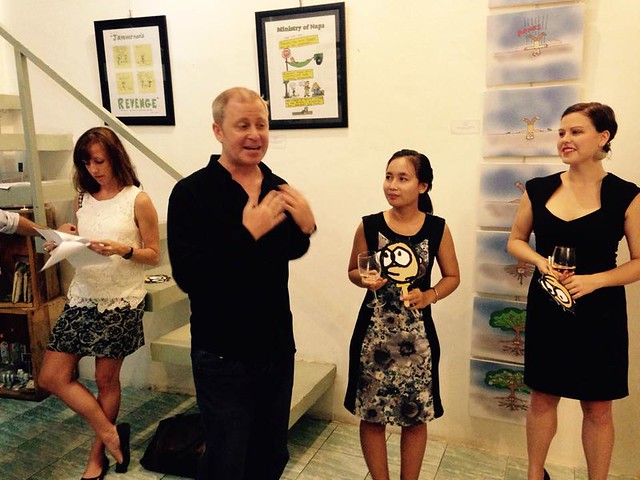
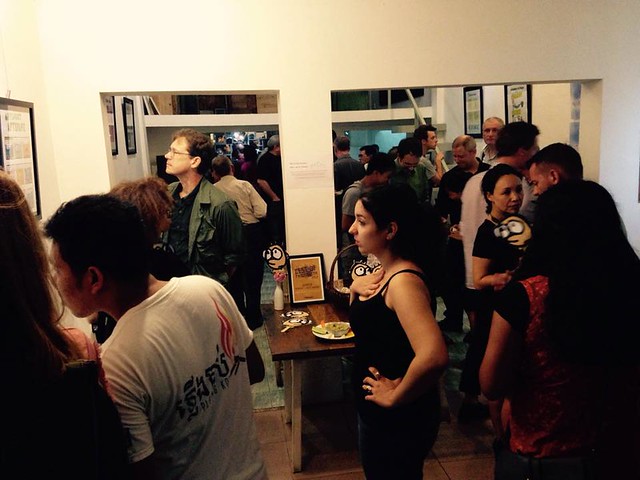
“Basically, the copyright rests with whoever has the best original copy,” said John Weeks, curator of “Comics of Cambodia,” an exhibition at the French Cultural Center through early November. “Many of the comics today are reprints from the [19]80s or even before.” … “Artists today are sitting on their comics because they’re afraid they’re going to get bootlegged and copied,” Weeks said. “Cambodia is full of stories. It would be great to see these stories celebrated more.” read more…»